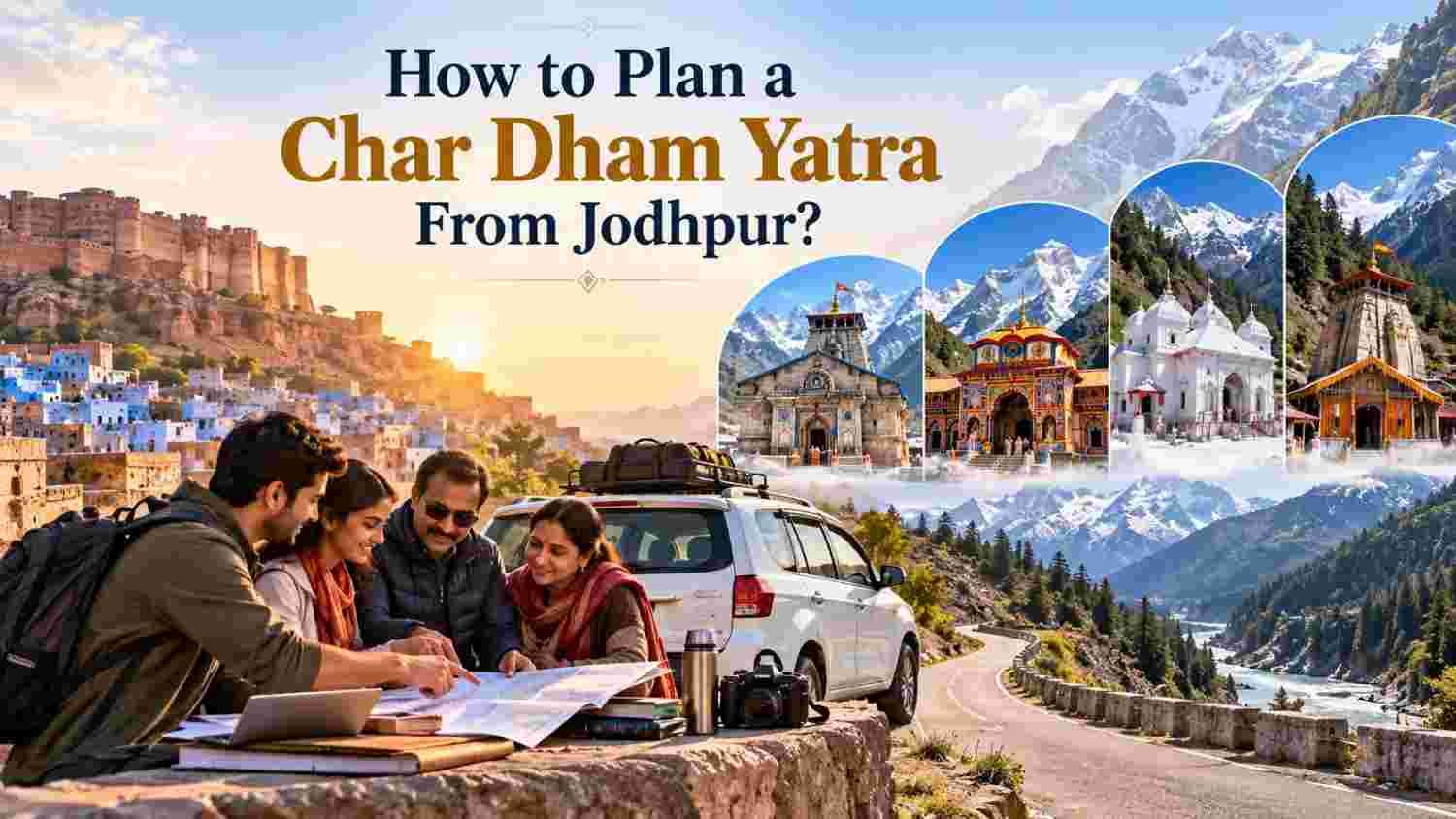
Travelling from Jodhpur to the Uttarakhand Char Dham involves two distinct stages: reaching a suitable gateway in Uttarakhand and completing the mountain circuit covering four shrine areas. A workable plan must coordinate transport, pilgrimage dates, accommodation, registration, Kedarnath access, physical preparation, weather conditions and sufficient contingency time. Mountain travel also differs significantly from ordinary intercity road journeys in Rajasthan. Rather than building the schedule around distance alone, travellers should consider road conditions, walking requirements, rest, seasonal changes and the needs of every person in the group.
Clarify What the Uttarakhand Char Dham Circuit Includes
The Uttarakhand Char Dham circuit comprises Yamunotri, Gangotri, Kedarnath and Badrinath. It differs from the broader pan-India Char Dham tradition, so travellers planning from Jodhpur should ensure that their transport, accommodation and bookings relate specifically to these four Uttarakhand pilgrimage destinations.
Pilgrims commonly follow the sequence:
- Yamunotri
- Gangotri
- Kedarnath
- Badrinath
This order provides a practical geographical framework for planning the circuit. However, actual arrangements can change according to road conditions, accommodation, official measures, weather and individual requirements. Therefore, travellers should avoid treating a sample itinerary as an unchangeable schedule.
Choose the Travel Period Before Fixing the Route
Pilgrimage dates influence almost every subsequent decision. Shrine opening periods vary by year, while weather, visitor movement, accommodation availability and road conditions can also change through the season. Travellers should verify current shrine information before committing to non-refundable transport or accommodation.
Early-season journeys may involve different weather and demand conditions from peak periods. Meanwhile, monsoon-affected travel requires particular attention to current road and weather information. Later-season journeys can bring another set of temperature and daylight considerations.
No period guarantees predictable mountain conditions. Consequently, the practical approach is to select tentative dates first, verify current official information, and then build transport and accommodation around those confirmed dates.
Separate the Jodhpur Connection From the Mountain Circuit
Planning becomes clearer when travellers divide the journey into two parts. The first stage takes the group from Jodhpur towards a suitable Uttarakhand gateway region. The second covers the actual mountain pilgrimage.
Haridwar, Rishikesh and Dehradun can play different roles in travel arrangements, depending on how the group reaches Uttarakhand and where its onward transport begins. None needs to be treated as the only possible gateway.
Choose How to Reach Uttarakhand
Travellers can consider several broad transport arrangements:
- train followed by road transport;
- flight followed by onward road transport;
- private vehicle or taxi from Jodhpur;
- a combination of rail, air and road services.
The suitable choice depends on available days, group size, luggage, budget structure, senior travellers and tolerance for prolonged road travel.
A family that values flexibility may prefer private road transport for more of the journey. In contrast, another group may use rail or air travel for the first stage and arrange a separate vehicle for the mountain circuit. The latter arrangement reduces one type of road journey but still requires detailed planning for Uttarakhand.
Before booking separate tickets, check how arrival time connects with the onward road schedule. A late arrival followed immediately by a demanding mountain journey may create an unnecessarily tiring first day.
Build the Circuit Around Geographic Progression
Treating every shrine as an independent return journey can create unnecessary movement. The commonly followed Yamunotri–Gangotri–Kedarnath–Badrinath sequence gives travellers a logical framework for moving through the circuit.
However, the practical itinerary also involves intermediate overnight points, road-access locations and transfers. Accommodation should therefore follow the route rather than simply the names of the four shrines.
Avoid filling every day with the maximum possible movement. Mountain roads can involve slower travel, traffic controls, changing conditions and longer stops than a map-based calculation suggests. Furthermore, walking sections and early departures can increase fatigue even when the road distance appears modest.
Keep Enough Days for the Complete Journey
The total schedule must include both the Jodhpur connection and the Uttarakhand circuit. It should also account for transfers, overnight halts, walking portions, check-ins, meals and adequate rest.
A tightly packed itinerary can become difficult to maintain after one significant delay. Instead, leave reasonable flexibility around demanding sections and before fixed return connections.
Several factors can lengthen a travel day:
- slower movement on mountain roads;
- traffic or temporary movement controls;
- changing weather;
- pilgrimage congestion;
- walking and trekking requirements;
- transfer points;
- accommodation check-in procedures;
- rest requirements;
- itinerary changes.
For example, a family travelling with older members may prefer shorter daily road periods and additional rest. Another group with stronger mobility and fewer constraints may structure its days differently. The itinerary should reflect the people travelling rather than an advertised minimum duration.
Plan Kedarnath as a Separate Access Requirement
Kedarnath requires additional logistical planning because the complete approach does not function like an ordinary road transfer to a hotel or town centre. Travellers need to coordinate the road-access portion with the onward approach towards the shrine.
Assess the Trekking Requirement Early
Anyone intending to complete the approach on foot should consider mobility, physical capacity, footwear, weather protection and the amount of luggage carried. Do not wait until reaching the access area to decide how every group member will manage the onward journey.
Travellers with health concerns, significant mobility limitations, pregnancy, age-related concerns or medical conditions should seek appropriate medical advice before planning physically demanding portions.
Treat Alternative Access Arrangements Separately
Authorised alternatives may be available under applicable seasonal arrangements. Where travellers intend to use helicopter or other authorised services, they should verify current booking procedures, reporting requirements, operating conditions and availability through official channels.
Helicopter operations can depend on weather and operational conditions, so a booking should not encourage travellers to remove all contingency time from the itinerary.
Complete Current Yatra Registration Requirements
Char Dham procedures can change between pilgrimage seasons. Travellers should therefore check current official requirements rather than relying on instructions saved from an earlier trip or forwarded through social media.
Registration forms part of the current official pilgrimage process. Before departure, verify the applicable procedure, traveller information requirements, identification documents, destination dates and any vehicle-related formalities relevant to the chosen mode of travel.
Keep required confirmations accessible during the journey rather than storing the only copy on a device that may become unavailable.
Where a package organiser offers registration assistance, clarify what “assistance” means. Travellers should still check that their individual details, intended destinations and dates have been entered correctly.
Plan Accommodation According to Each Travel Day
Accommodation should support the next day’s route. A room that appears convenient geographically may create an inconvenient departure if it lies far from the next transfer or access point.
Before booking, check:
- overnight location;
- room configuration;
- accessibility requirements;
- distance from the next departure point;
- meal availability;
- parking where relevant;
- hot-water arrangements where required;
- cancellation and modification conditions.
Families should also verify room-sharing arrangements rather than assuming that a quoted package price automatically provides their preferred configuration.
During busy periods, availability can affect itinerary choices. However, booking far ahead does not remove the need to reconfirm arrangements close to departure.
Compare Independent Planning With Organised Arrangements
Independent travel gives the group direct control over transport, accommodation and itinerary decisions. An organised arrangement can consolidate several components under one booking. Neither approach automatically suits every traveller.
Someone comparing a char dham yatra package from jodhpur should first establish exactly where the included journey starts and ends. Some arrangements may cover the Rajasthan connection, while others may begin only after travellers reach an Uttarakhand gateway.
Compare the following components rather than relying solely on the headline price:
- transport from Jodhpur;
- Uttarakhand road transport;
- vehicle category;
- accommodation and room sharing;
- included meals;
- registration assistance;
- Kedarnath arrangements;
- tolls and parking;
- driver-related charges;
- optional stops;
- exclusions;
- cancellation and refund conditions;
- itinerary-change provisions.
If one quotation includes more transport or meals than another, their total prices do not represent equivalent products.
Check Private Vehicle and Taxi Arrangements Carefully
Private road transport can provide flexibility for families and groups, but the quotation should define the arrangement clearly. Ask which vehicle category will be supplied and assess both passenger and luggage capacity.
Clarify where kilometre calculation begins and ends, particularly for multi-day bookings. Also ask about daily travel arrangements, waiting, additional kilometres, tolls, parking, driver allowance and overnight requirements where applicable.
A useful written booking confirmation should identify:
- pickup and final drop;
- vehicle category;
- planned route;
- trip duration;
- fare basis;
- inclusions and exclusions;
- additional-charge basis;
- itinerary-change conditions;
- replacement arrangements if the vehicle develops a problem.
Do not assume that every taxi booking follows identical pricing rules.
Prepare for Altitude, Walking and Long Travel Days
The pilgrimage combines road travel with varying levels of walking and physical effort. Changing temperatures, altitude and consecutive travel days can affect people differently.
Physical preparation should match individual needs rather than age labels alone. An active older traveller may have different requirements from a younger person with mobility or health concerns.
Anyone with relevant medical conditions should discuss demanding travel plans with an appropriate healthcare professional. Travellers should also carry prescribed personal medicines according to professional instructions and plan how necessary medication will remain accessible during road and walking sections.
Give Families and Senior Travellers More Flexibility
Groups containing children, older family members or anyone with limited mobility should consider the pace of the entire itinerary.
Practical adjustments may include:
- shorter travel days;
- additional rest periods;
- accessible accommodation;
- manageable luggage;
- planned meal stops;
- regular toilet breaks;
- suitable walking arrangements;
- easy access to medicines;
- additional weather protection;
- contingency time.
Avoid designing the schedule around the fastest member of the group. A pilgrimage itinerary works better when daily movement reflects the person who needs the most practical support.
Pack for Changing Mountain Conditions
Packing should reflect the season, planned walking and changing temperatures rather than ordinary Rajasthan travel conditions. Compact luggage also makes transfers easier, particularly where travellers need to separate essential items from bags left with a vehicle or accommodation.
Useful categories include:
- layered clothing;
- suitable rain protection;
- comfortable walking footwear;
- personal medicines;
- valid identification;
- essential booking confirmations;
- compact day luggage;
- water and suitable snacks;
- personal-care essentials;
- power bank;
- sun protection.
Seasonal requirements can vary substantially, so check current conditions before final packing.
Allow Weather to Influence the Schedule
Mountain weather can affect road movement, trekking, visibility, departure times and aviation-dependent arrangements. Consequently, travellers should avoid assuming that every planned stage will operate exactly on schedule.
Heavy rainfall can also affect mountain travel conditions. Rather than relying on general seasonal assumptions, check current official weather and route information close to each relevant travel period.
Buffer time becomes particularly useful when the return journey connects with a fixed train, flight or work commitment. Keeping additional flexibility before that connection can prevent one delayed mountain segment from affecting several subsequent bookings.
Plan Meals and Hydration Around Travel Days
Early departures and long road sections can make normal meal routines difficult. Check whether accommodation or organised arrangements include breakfast and dinner, particularly when departure occurs early.
Travellers with specific dietary requirements should communicate them before booking where meals form part of the arrangement. Carrying suitable compact snacks can also help during longer stages where meal timing remains uncertain.
Water should remain accessible during road and walking portions. However, travellers with medical restrictions relating to diet or fluid intake should follow professional advice relevant to their condition.
Build the Budget From Individual Cost Categories
A realistic budget should not rely on one generic estimate because trip duration, transport, group size, accommodation and optional services can change the total substantially.
Calculate separate amounts for:
- Jodhpur-to-Uttarakhand transport;
- road travel within Uttarakhand;
- accommodation;
- meals not included elsewhere;
- tolls and parking where applicable;
- official charges, if applicable;
- Kedarnath access arrangements;
- authorised porter, pony, palki or similar services where required;
- personal purchases;
- contingency funds.
Separating these categories also makes package comparison easier because travellers can identify which expenses remain outside the quoted amount.
Check Every Package Before Making Payment
A package name alone does not define what the traveller receives. Ask for a written itinerary and verify the starting point, ending point, transport, accommodation and exclusions.
Before payment, check:
- exact itinerary and pilgrimage destinations;
- transport from Jodhpur, if included;
- vehicle category;
- accommodation category;
- room-sharing arrangement;
- included meals;
- registration support;
- Kedarnath-specific arrangements;
- toll and parking treatment;
- driver-related charges;
- exclusions and optional services;
- cancellation and refund conditions;
- itinerary-change policy;
- arrangements for significant disruptions.
Not every package needs to include every listed component. Clarity matters more than the number of inclusions.
Use a Practical Planning Sequence
A staged approach prevents travellers from booking later components before confirming the decisions that control them.
- Select a suitable pilgrimage period.
- Verify current shrine and registration information.
- Choose transport from Jodhpur towards Uttarakhand.
- Build the four-shrine circuit.
- Allocate realistic travel and rest time.
- Arrange road transport and accommodation.
- Plan Kedarnath access separately.
- Prepare required documents and personal necessities.
- Recheck weather and route conditions.
- Reconfirm major bookings shortly before departure.
This sequence keeps dependent decisions in the correct order. For instance, accommodation locations make more sense after the circuit and transport structure have been established.
Complete a Final Check Before Leaving Jodhpur
Conditions and operational arrangements can change after the initial booking. A final review should therefore focus on current information rather than reopening every planning decision.
Confirm:
- shrine-related current information;
- Yatra registration status;
- identity documents;
- train, flight or road arrangements;
- Uttarakhand vehicle booking;
- accommodation confirmations;
- Kedarnath access plan;
- current weather information;
- current route information;
- required medicines;
- suitable clothing and footwear;
- payment and booking records;
- emergency contacts;
- return connection;
- available contingency time.
Keep essential documents and confirmations accessible to more than one responsible group member where practical.
Conclusion
Planning the pilgrimage from Jodhpur requires coordination between the Rajasthan-to-Uttarakhand connection and a very different mountain circuit. Transport, registration, accommodation, Kedarnath access, physical needs, weather and schedule flexibility should work together rather than exist as separate bookings. Current official information deserves a final check because pilgrimage procedures and operating conditions can change. A realistic itinerary also leaves enough flexibility for the group to respond to delays without placing every subsequent reservation under pressure.
FAQs
How many days should travellers keep for the Char Dham Yatra from Jodhpur?
There is no single duration suitable for every group. The schedule depends on transport from Jodhpur, daily road movement, walking requirements, rest, Kedarnath arrangements and return connections. Families and groups with older travellers may prefer additional time. Build the itinerary from actual travel stages and retain contingency time.
Which Char Dham shrine is generally visited first?
Yamunotri commonly forms the first destination in the traditional Uttarakhand circuit, followed by Gangotri, Kedarnath and Badrinath. However, travellers should build the actual itinerary around current operating conditions, accommodation, transport and official arrangements rather than assuming that a sample sequence guarantees a fixed daily schedule.
How can travellers reach Uttarakhand from Jodhpur?
Possible arrangements include rail travel followed by road transport, a flight combined with an onward road journey, a private vehicle, or mixed transport. Compare total available time, group size, luggage, comfort requirements and continuous road travel before choosing. The mountain circuit will still require suitable onward transport planning.
Does the Char Dham Yatra require registration?
Registration forms part of the current official Char Dham pilgrimage process. Because procedures and requirements can change between seasons, verify the applicable process through current Uttarakhand official information before departure. Ensure that traveller details and intended destinations are recorded correctly, and keep the required registration confirmation accessible during the pilgrimage.
When should accommodation be booked for Char Dham?
Book after establishing the travel period, circuit and likely overnight locations. Demand can vary across the pilgrimage season, so earlier planning may provide more choices. However, travellers should also review cancellation conditions and reconfirm bookings before travel because route, weather or operational changes can affect the practical itinerary.
Can senior citizens undertake the Char Dham Yatra?
Age alone does not determine an individual’s suitability for the pilgrimage. Mobility, existing health concerns, walking capacity, altitude exposure and tolerance for long road journeys all matter. Older travellers with relevant medical concerns should seek appropriate medical advice and consider shorter travel days, additional rest and accessible accommodation.
How should travellers prepare for Kedarnath?
Plan the road-access stage and onward approach separately. Consider walking capacity, footwear, weather protection, compact luggage and rest. Anyone considering authorised alternative transport should verify current availability, booking procedures and reporting requirements through official information. Do not structure the entire return schedule around an assumption that weather-dependent services will operate without disruption.
What clothing should travellers carry for Char Dham?
Layered clothing allows travellers to respond to temperature changes across locations and times of day. Depending on current conditions, rain protection, warm layers, comfortable walking footwear and sun protection may also prove useful. Check the weather shortly before departure rather than relying solely on general seasonal expectations when packing.
How much does a Char Dham trip from Jodhpur cost?
Total expenditure varies according to transport, group size, duration, accommodation standard, meals and optional services. Build the budget from separate categories such as Jodhpur connections, Uttarakhand transport, rooms, food, applicable road expenses, Kedarnath arrangements and contingency funds instead of relying on a generic trip estimate.
What should travellers verify shortly before leaving Jodhpur?
Reconfirm registration, transport, accommodation, identification documents, Kedarnath arrangements, weather information, route conditions and return connections. Check that required medicines, clothing and booking records are accessible. Because pilgrimage conditions can change, current official information should take priority over old itineraries, forwarded messages or details retained from previous seasons.
Leave a Reply